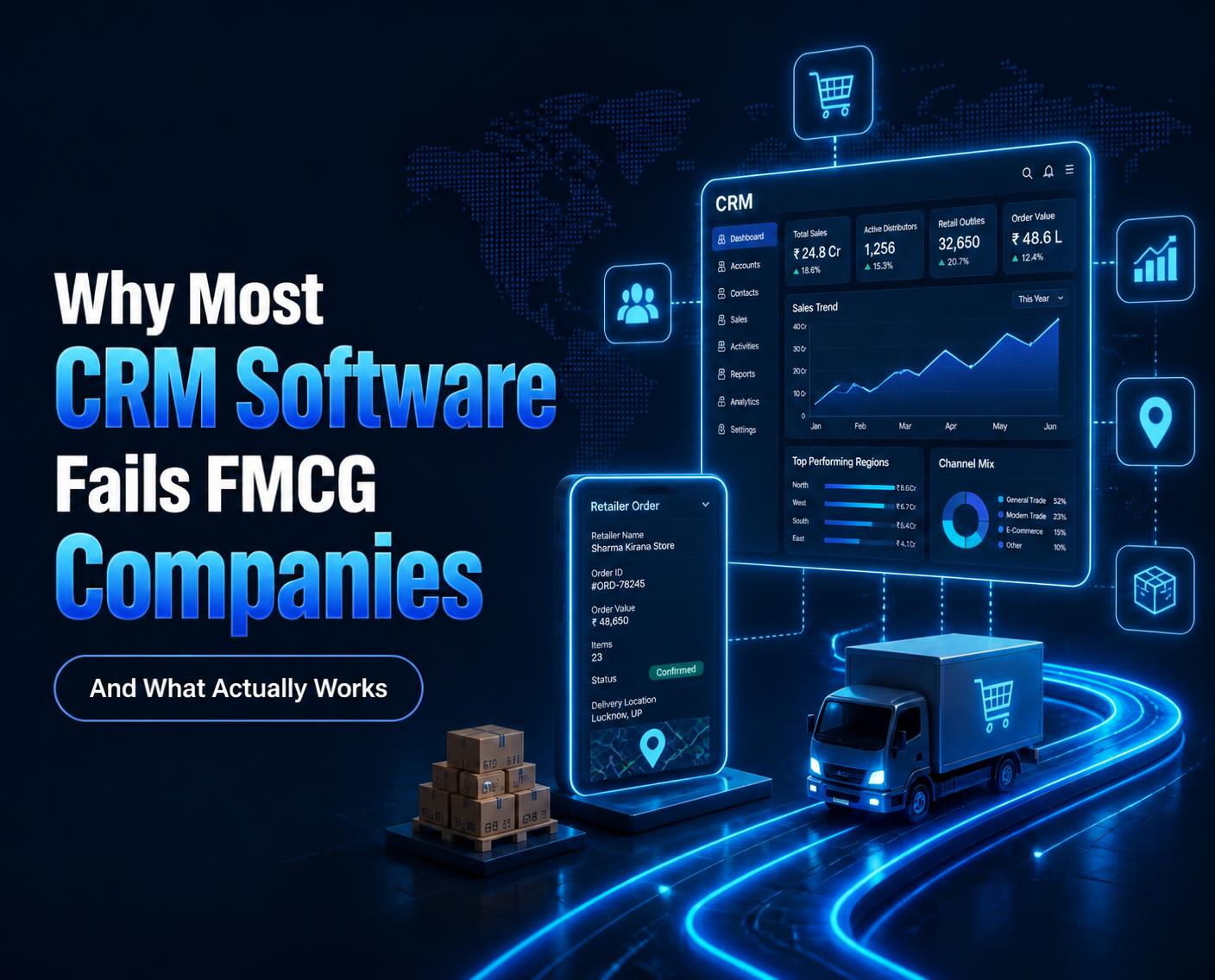


Most CRM software was never actually built for how FMCG companies work. It was built for sales teams closing a handful of big deals a month, tracking one lead at a time through a slow pipeline. FMCG runs nothing like that; it runs on hundreds of retailers, dozens of distributors, and daily order cycles where a sales rep might visit twenty outlets before lunch. When a business tries to force that daily reality into a generic CRM built for a completely different sales motion, something usually breaks.
What the research actually shows
A study published on CRM adoption in FMCG companies found that businesses in India using CRM systems saw sales productivity improve by around 25%, alongside a 20% improvement in customer service efficiency, over a five-year period. That’s not a small number, a quarter more sales productivity, from the same team, just by giving them a system built around how they actually sell.
The reason this jump happens is straightforward once you see it: FMCG sales reps spend most of their day in the field, not at a desk. If they can’t instantly pull up a retailer’s order history, credit limit, or last delivery date on the spot, they’re either guessing or calling someone back at the office and losing time. A properly set up CRM removes that back-and-forth entirely.
Where generic CRM software falls short
Generic CRM platforms are genuinely good at what they’re designed for managing long B2B sales cycles, tracking a small number of high-value leads, and forecasting a deal pipeline. FMCG doesn’t have any of that. It has daily order cycles, thousands of small transactions, and sales reps who need instant access to information while standing in a retailer’s shop, not back at a desk filling in a form later.
Generic CRM vs. an FMCG-built system
| Generic CRM | FMCG-Specific CRM | |
| Built for | Long B2B sales cycles | Daily order cycles, high transaction volume |
| Field sales support | Limited | Built-in, real-time |
| Distributor & retailer tracking | Basic contact records | Full order history, credit limits, zone assignment |
| Inventory visibility | Not included | Built in, tied to actual orders |
| Demand forecasting | Not designed for it | Core feature |
What a properly built CRM actually gives an FMCG business
A system built for this industry does a few things a generic one simply can’t. It gives every field rep instant access to a retailer’s full order history and any special instructions the moment they walk in, so they’re never guessing or making a call to check. It tracks distributor and retailer relationships by zone, so a sales manager can see exactly which accounts are being covered and which are quietly going inactive. It ties stock levels directly to actual order data, so a warehouse manager isn’t relying on a spreadsheet that’s already a week out of date. And it gives leadership a real-time view of what’s actually selling, region by region, instead of waiting for a monthly report to find out something changed weeks ago.
Why this matters more as a business grows
A five-outlet business can often get by on manual tracking and a shared spreadsheet. A business managing fifty distributors and several hundred retail touchpoints genuinely cannot not because the team isn’t capable, but because the sheer volume of daily information makes manual tracking mathematically impossible to keep accurate. This is usually the exact point where FMCG businesses realize their existing system, generic CRM or otherwise, has quietly become the bottleneck slowing everything else down.
Looking for IT solutions built around how your FMCG company actually operates? Talk to Quadrant IT Services about CRM and ERP solutions for retail and FMCG businesses.
Frequently Asked Questions
What makes CRM for FMCG different from regular CRM software?
Regular CRM software is built around long B2B sales cycles and a small number of high-value deals. FMCG CRM is built around daily order cycles, high transaction volume, and field sales reps who need real-time access to retailer and distributor information on the spot.
Can a small FMCG business benefit from this, or is it only useful at scale?
Smaller FMCG businesses can benefit too, but the impact grows sharply as the number of distributors and retail touchpoints increases past a certain size, manual tracking simply can’t keep up with the volume of daily information.
Does CRM for FMCG help with inventory as well as sales?
Yes. A properly built FMCG CRM ties stock and order data together directly, which helps businesses avoid both running out of fast-moving products and overordering slow-moving ones.
How long does it typically take to see results after switching to an FMCG-specific CRM?
Based on industry research, businesses generally start seeing measurable improvements in sales productivity and service efficiency within the first year of proper implementation, with gains continuing as the system and team adapt to it.